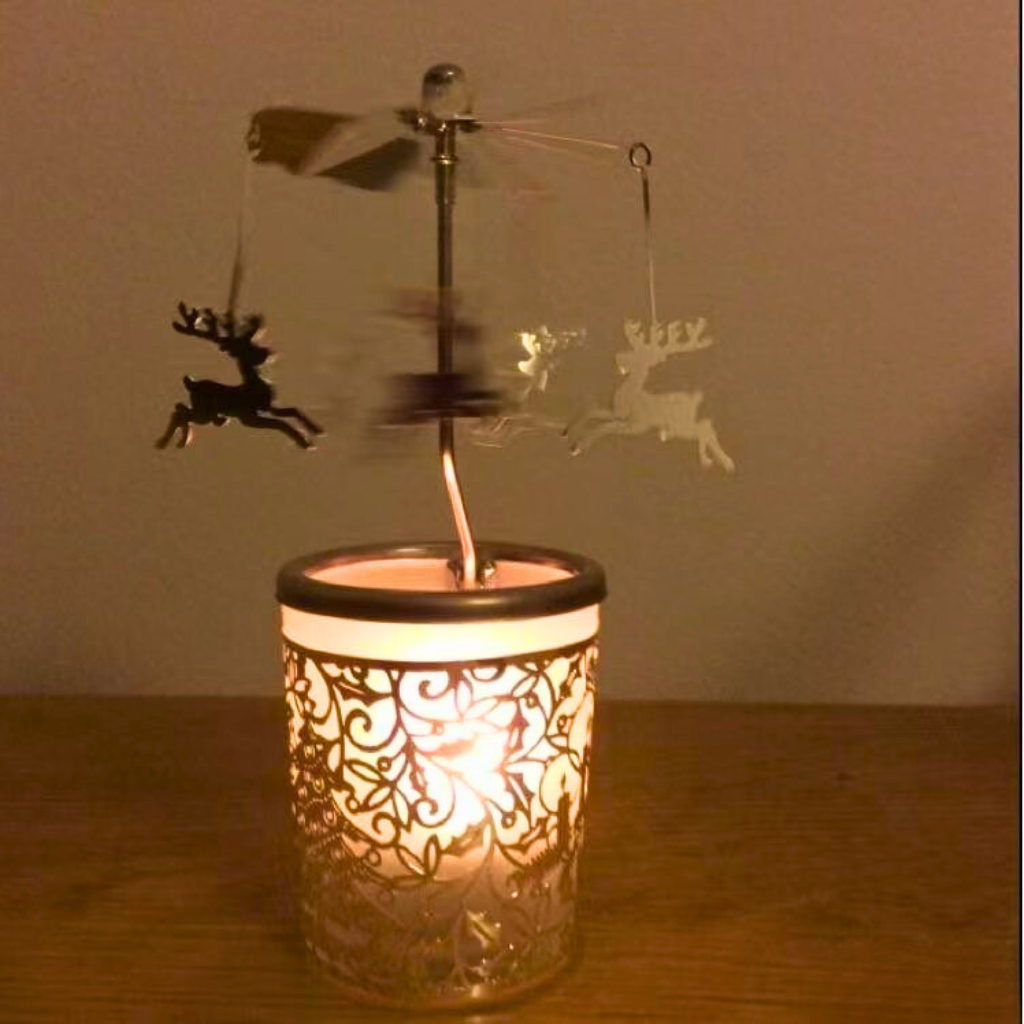
I was around twenty when I bought a small candle lamp from a Christmas market in Heidelberg.
When the candle was lit, the flame created a subtle breeze, and that breeze set tiny reindeers spinning above.
I remember staring at it for a long time.
It was a precious moment—my mind emptied, completely.
It was just the two of us, the flame and me, quietly illuminating each other.
Time seemed to vanish, the moment became translucent, suspended, immaculate.
Years later, when I looked again at a photo of that moment, I felt an unexpected urge to cry.
I realized then: that was delicate yin fire (丁火) in winter—wrapped in the etched metal of Xīnjīn (辛金), flickering alone in the coldest night.
That image—was me.
That was the elemental symbol of my life.
At first, I believed these Bāzì (八字) images—life elements drawn from birth data—were just a private language.
I made it my own romantic system of symbols, ritualized fantasies kept in a hidden corner, a secret code generating images of different souls.
But these symbols have a strange way of returning.
They seem reflections of single moments, yet they stumble through time and resurface repeatedly, as if something primal is insisting upon itself.
They don’t just describe us.
They echo through us.
I once read how Carl Jung described his relationship with the self.
Then, curious, I calculated his Bāzì chart:
He was born with Yǐ Hài, Guǐ Wèi, Jǐ Chǒu, Jiǎ Xū (乙亥 癸未 己丑 甲戌)—
creating an image of mid-summer earth, with three collision-prone branches (Chǒu, Wèi, Xū), a landscape of compression, dryness, and internal strife.
He wrote:
“I did not expect that my self would be a desert, a dry, hot desert, full of dust and without water.
Why is my self a desert?
Have I lived too much outside of myself in men and events?
Why did I avoid my self?
Was I not dear to myself?
But I have avoided the place of my soul.”
In that passage, Jung touches something essential.
His desert is not exactly his Bāzì image. Because there are also plenty of water and wood among his pillars —a balanced yet powerful earthscape. And yet he wondered:
“Should I also make a garden out of the desert?
Should I people a desolate land?
Should I open the airy magic garden of the wilderness?”
This matching always strikes my heart. Among philosophers, many use forests to symbolize the soul. Nietzsche’s six characters( without the hour pillar): Jiǎ Chén, Jiǎ Xū, Wù Chén (甲辰 甲戌 戊辰), formed an image consisting solely of trees and mountains. He once wrote:
“But it is the same with man as with the tree.The more he seeks to rise into the height and light, the more vigorously do his roots struggle earthward, downward, into the dark and deep—into the evil.”
And in Thus Spoke Zarathustra, he says:
“I am a forest, and a night of dark trees. but he who is not afraid of my darkness, will find banks full of roses under my cypresses.”
Some souls are forests.
Others are rivers.
Some are lanterns suspended in frozen air.
And each tries name its own shape.
The soul has its own world. A world written not in definitions, but in flowing symbols. Each symbol here holds a singular meaning—difficult to interpret yet unmistakably real.
Jung said: only the true self can enter this space. Or rather, only one who has entirely become their own self—who lives neither in society, nor in the opinions of others, nor even in ideas—can enter.
I think, for those who sincerely long for this kind of selfhood—
the world may still wink at them.
Brief flashes of synchronicity break through the veil.
Glimmers of the code flicker in the margins.
From a philosophical and healing perspective, I take these elemental images of birth chart seriously.
Ancient divine worlds lived entirely through cultural symbols.
So does Eastern thought.
Our task now is to bring those symbols into conversation with modern civilization.
20岁左右的时候,我在海德堡的圣诞集市买了一个小小的烛灯。
点上蜡烛之后,火苗会带来空气的翕动,那一点细微的风让上方的驯鹿旋转飞舞。
我一直凝视着它,像我这样难以专注的人,在那一刻心里却容不下其他。仿佛世界只余彼此,互相照见,连时间都变得无暇而可视。
过几年我再次看到这张照片,依然有一种想要恸哭的感觉。
再后来,我想,原来这是冬天的丁火,镂着辛金的外表,置身于一个寒冷的暗夜。
那是我。我自己的生命意象。
我原以为八字意象是自我的浪漫与狂欢,是在角落守着一个神圣有趣的秘密。但这种共时性在四面八方都能找见踪影,它跌跌撞撞地重复出现,带着源自本初的命中注定。
我看着卡尔·荣格描绘自己的本我的文字。然后排出了他的八字。乾造:乙亥 癸未 己丑 甲戌。
我没有想到我的灵魂是一个沙漠,一片干燥炎热的沙漠,沙尘弥漫,也无水喝。
为什么我的原我是一片沙漠?是我脱离常人和世事太久?我为什么要逃避自己的原我?是我太不珍惜自己?我逃避的是自己的灵魂所在的地方。
只有当原我是沙漠的时候,才是真正的孤独。我也应该在沙漠中建造出一座花园吗?我要成为一片荒芜之地的居民吗?我可以开放荒漠里的空中魔法花园吗?
他的八字意象当然不等同于沙漠。只是季夏己土,丑未戌刑冲,无垠的荒漠感率先铺满了画卷,其后是孤独与纠葛的生命力,己身也完全化作了自己的思想。
哲学家中,用森林来象征自己的灵魂者占更多数。尼采(乾造:甲辰 甲戌 戊辰)说:人和树是一个道理。他越是想上升到高处和亮处,他的根就越是努力向地里扎,向下面,向暗处,向深处,向恶之中。
几乎将本我和自我的生命力写尽,亦吻合八字的景象。他在《查拉图斯特拉如是说》中更写道:我确是有着幽深树木的黑暗的森林。可是不畏惧我的黑暗的人,也会在我的柏树下面看到玫瑰花的斜坡。
灵魂拥有自己的独特世界,那是书写着独一无二的象征意义的流动世界。荣格说,只有本我能够进入到这里,或者完全成为自己的本我之人才能够进入到这里,这样的人既不在世事中,也不在常人中,更不在自己的思想中。
但思念着自己的本我之人,世界会向他眨眼,短暂地闪动出灵感的交错。
沿哲学的角度拓展,从疗愈的意义出发,我更无限地重视八字的意象。整个古代神性世界皆生活在意象中,东方智慧的意义也皆在意象中。祂们如何与世界文明和现代美学接轨,即是我们的功课。